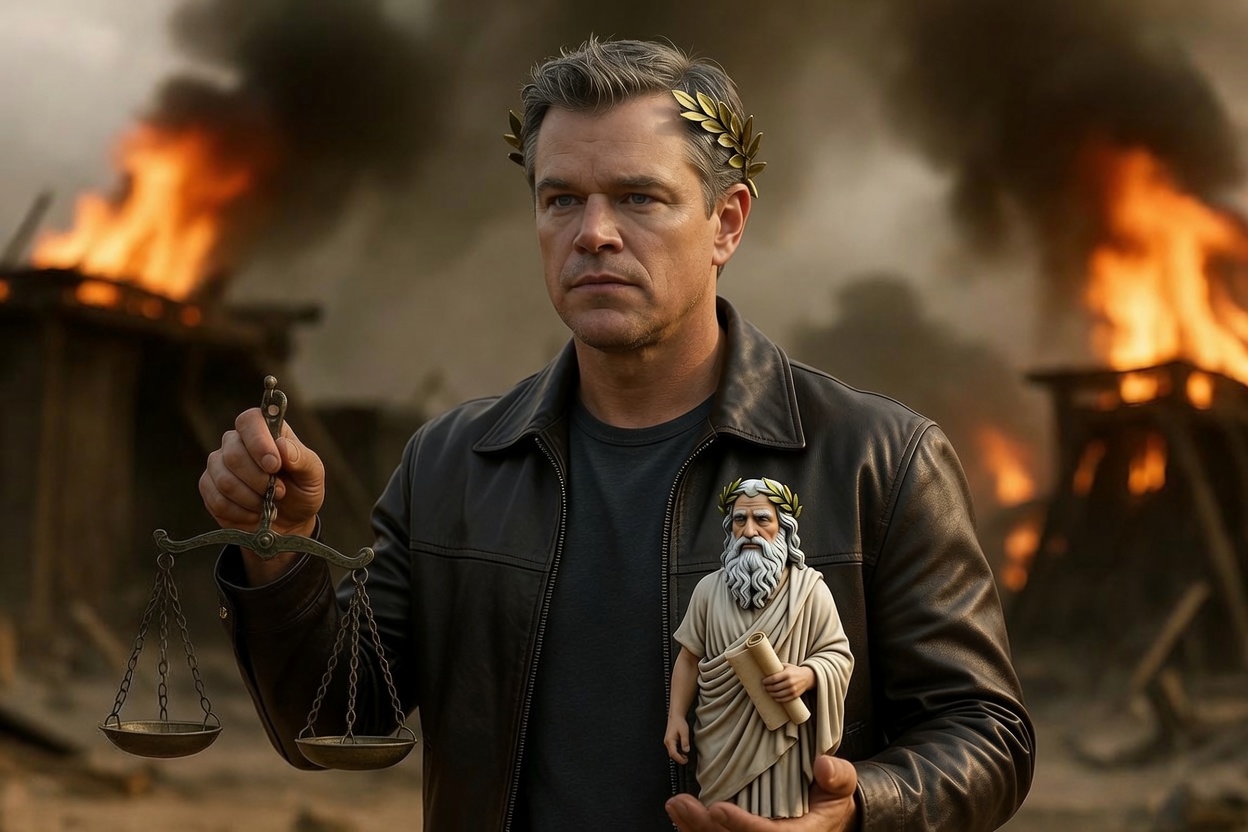
Screenmancer Art Dept. (c) 2026
by Quendrith Johnson, Los Angeles Correspondent
Let’s start at the top, shall we, in our defense of Christopher Nolan’s The Odyssey? The movie, starring Matt Damon, Tom Holland, Anne Hathaway, and released in late-July by Universal, has been targeted by some very astute and well-aimed criticism. Why? Surely not due to Nolan’s ambitious IMAX interpretation, its American street talk, and broadly drawn casting? No, because this movie has accidentally started the biggest Homer debate in half a century.
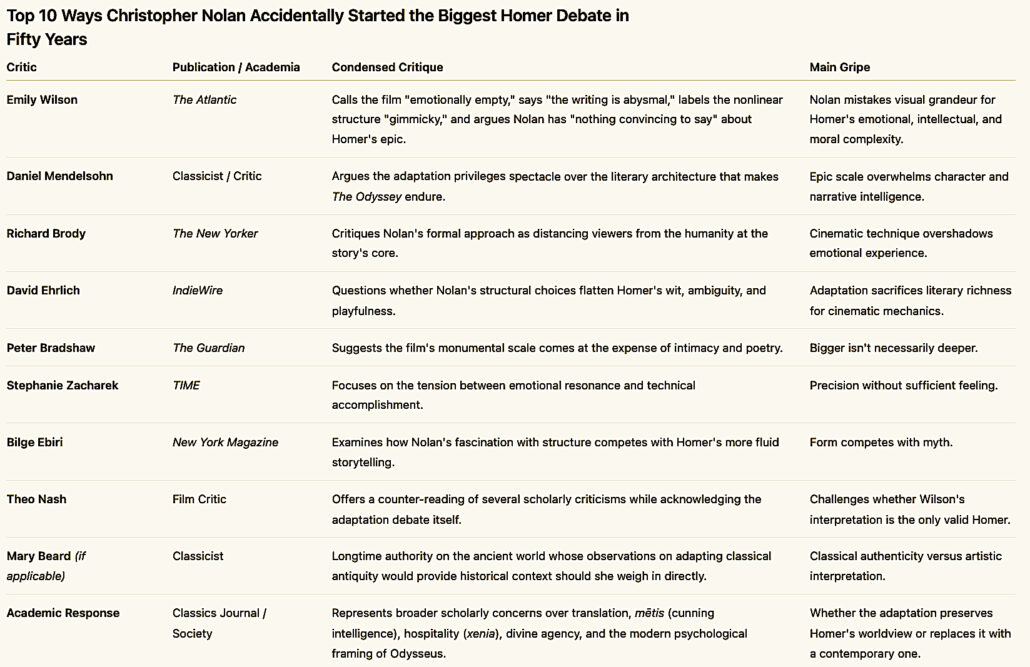
So we decided to cover the spat. Specifically to debunk the Top 10 Arrows that Singed Nolan’s Odyssey… or better yet? To deconstruct the Top 10 Main Gripes from The Atlantic to random academics on blast. Can you imagine Nolan having to fend off critics and the Ivory Tower, for resurrecting a Homeric Epic that would otherwise still be gathering dust?
Meanwhile, this is just the warm-up, because – wait for it – The Odyssey isn’t just a movie, it’s an emotional weather pattern that creates it own atmosphere, with a Nolanian crescendo of magnificence. Yes, this movie is very personal and emotional, unlike the diss from Classicist Emily Wilson.
Read on, and we’ll prove it… but first, the Diss List.
Top 10 Odyssey Gripe List from The Atlantic to TIME to Random Academics
10. “Nolan fundamentally misunderstands The Odyssey.” The master criticism beneath every other complaint. Emily Wilson argues Homer’s epic poem is fundamentally about intelligence, hospitality, disguise, competing truths, storytelling, memory, and the price of empire. Whereas Nolan’s version, she contends, narrows that sprawling human saga into a one-hit wonder warrior trying to get home. For Wilson—and many other Random Classicists—that narrative shift isn’t merely an adaptation, it’s an affront, a fundamentally different Odyssey on screen.
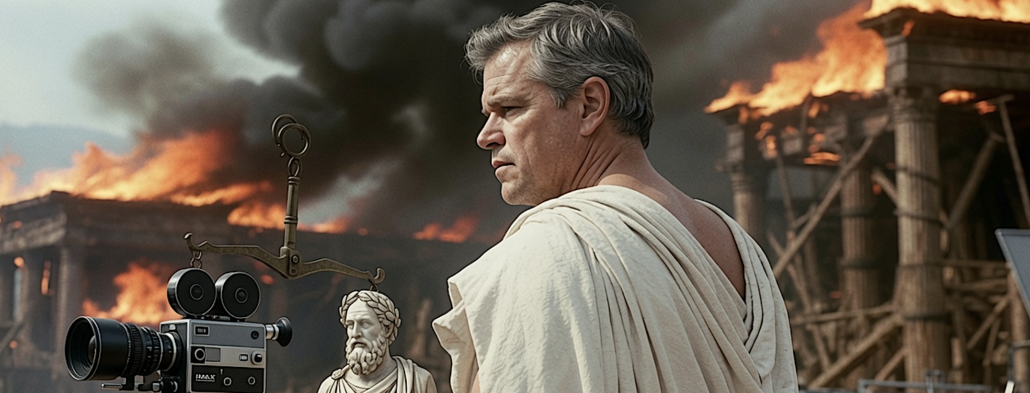
9. “A narrative muddle.” In a follow-up essay, Wilson describes the film as shallow, incoherent, morally confused, and ultimately unable to decide whether it’s condemning war or glorifying it.
8. “The writing is abysmal.” Her sharpest critique lands on the screenplay itself. Wilson later doubled down, remarking she would be embarrassed to have written dialogue like it.
7. “It has nothing convincing to say.” Wilson contends Nolan largely misses the themes that have sustained The Odyssey for nearly three millennia: memory, hospitality (xenia), history, family, storytelling, and the moral cost of war.
6. “Visually stunning, emotionally empty.” Perhaps the review’s defining phrase. Wilson praises the imagery while arguing the film largely evacuates the emotional richness that gives Homer’s poem its lasting power.
5. “Its narrative structure is gimmicky.” Wilson argues Nolan’s trademark fractured chronology doesn’t illuminate Homer—it merely Nolanizes Homer, turning the poem into another cinematic puzzle box.
4. “PTSD isn’t Odysseus.” Wilson’s central philosophical objection: Nolan recasts Odysseus as a traumatized modern veteran rather than Homer’s endlessly resourceful, shape-shifting strategist defined by mētis—cunning intelligence.
3. “It’s spectacle over substance.” Several classicists argued Nolan transforms Homer’s intimate epic into an IMAX war machine, where visual scale overwhelms the emotional architecture. Daniel Mendelsohn was among those arguing reflection gives way to action.
2. “Too loud. Again.” The oldest Nolan complaint has also returned home? Even favorable reviews acknowledged dialogue disappearing beneath Ludwig Göransson’s thunderous score and relentless battle sequences.
1. “The American accents sound like Ohio.” The first arrows flew before audiences even settled into their IMAX seats. Critics and social media users complained that Nolan’s cast sounded more suburban America than Bronze Age Greece, with quips like “More Ithaca, New York than Ithaca, Greece,” and “Sounds like they’re hanging around Starbucks.”
That last one, “The American accents sound like Ohio,” kills me every time. Hilarious, however, consider the The Wizard of Oz smackdown during its premiere in 1939 for Bert Lahr and the boys sounding like “Brooklyn”?
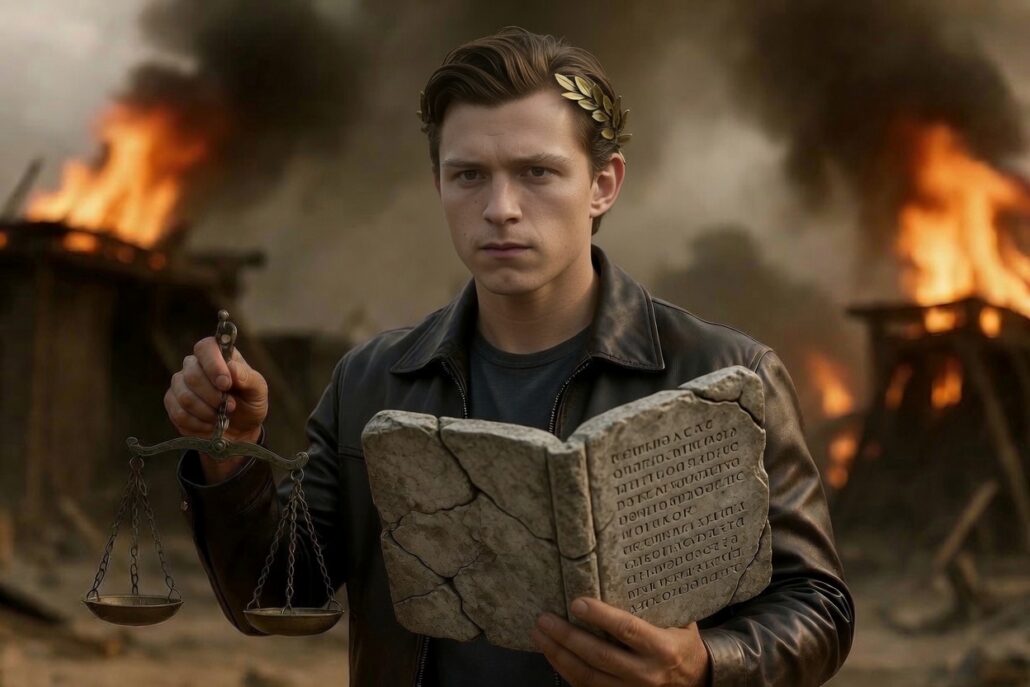
Yes, okay, Tom Holland’s Telemachus does use the word “Dad” instead of “Father,” which is kind of a break with Homeric tradition, to be kind.
But hopefully nobody cares in 87 years, like with Oz.
Meanwhile Back at The Box Office
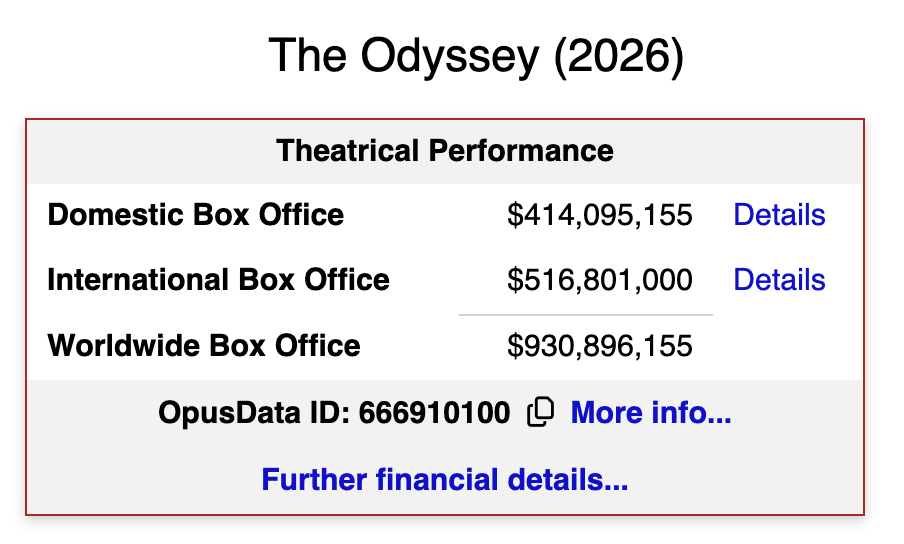
Shortsighted critics make pithy remarks, but global audiences are buying tickets to The Odyssey – clocking in at $930 M USD via The Numbers worldwide right now. In America, they also clap at the end of this movie in theaters.
(Editor’s note: based on Marina Del Rey, Rancho Cucamonga viewings.)
When was the last time you heard an audience clap at anything that wasn’t a Marvel or superhero rah-rah franchise film?
This is based on a Homeric Epic, folks, not graphic novel or comic-con masked Superhero slinging dialogue: and here’s where the celluloid hits the sprocket for me.
This is not just an IMAX spectacle with crashing gray surf, singed war-torn shores, or doughy mono-eyed beasts…
Viewed through the lens of partnership between Christopher Nolan and producer Emma Thomas, The Odyssey becomes less a fiery war-wagon epic, and more an emotionally dense, late-career love story about surviving decades of working together when the creative journey repeatedly tears you apart.
Now Let’s Really Defend Nolan & His Own Journey Home?
Read through the prism of Christopher Nolan’s 30-year creative journey with producer Emma Thomas, The Odyssey becomes a shockingly intimate film—not about slaying one-eyed monsters, but the fear of losing the woman you love.
This is a theme Nolan has revisited over and over in shades of the same protagonist: Leonard Shelby, trapped by memory; Bruce Wayne, sacrificing intimacy for duty; Dom Cobb, haunted by the loss of his wife; Cooper, separated from the family he loves by the vastness of space and time; J. Robert Oppenheimer, whose brilliance fractures his closest human ties.
These protagonists vanquish villains, manifest cosmic dreams, explore galaxies and even split the atom itself, yet remain emotionally at bay from the lives they must reclaim. Now comes Homer’s Odyssey— Nolan’s take on the greatest homecoming/lovestory ever written? Makes perfect sense, whether consciously or not, viewed autobiographically as paired with Emma Thomas, the film is the culmination of a creative life-long obsession, sacrifice, endurance race in filmmaking. An impossible journey Nolan made that ultimately leads back to the one person, Emma Thomas, who made it worth taking, thus a full circle in storytelling on screen and off-camera.
Thus Nolan, in the form of Matt Damon as Odysseus, shows us a flawed protagonist who makes mistakes, and corrects them with the knowledge that there are no do-overs in real life – such exquisite human moments, which makes them so easy to miss on screen, even by the ruling classicists.
So, if you don’t like The Odyssey, it’s because no one told you what to look for while you’re watching it, end of story.
Find the tickets here.
# # #
About The Author